“I would like to live in Ebisu at least once.”
If you have ever considered living alone in Tokyo, Ebisu may well have been one of the neighborhoods on your list.
It is only one stop from Shibuya, while Daikanyama and Hiro-o are also within easy reach as part of your everyday living area. Step outside the station and you will find numerous restaurants and cafés, making it convenient both for dinner after work and for a leisurely walk on your day off. It is the kind of neighborhood where simply living there seems likely to raise your “foodie IQ.”
However, Ebisu has one major drawback: rent for people living alone is expensive.
According to LIFULL HOME'S data as of August 2026, average rents within a 10-minute walk of Ebisu Station are ¥161,400 for a studio apartment, ¥156,900 for a 1K apartment, ¥217,300 for a 1DK apartment, and ¥302,800 for a 1LDK apartment.
“I want to live in Ebisu. However, paying more than ¥150,000 every month for an apartment of around 20 m², and then paying separately for electricity, gas, and water, is a considerable burden.”
For people who feel this way, a share house is not merely “inexpensive housing.” It is an option that allows you to change how you live without giving up on living in Ebisu.
This time, we compare FineMaison Ebisu, an eight-minute walk from Ebisu Station on all lines, with four standard rental apartments actually being advertised within a 10-minute walk of Ebisu Station.
We will not compare them solely on the basis of “rent plus management fees.”
FineMaison Ebisu’s ¥20,000 common service fee includes electricity, gas, water, shared household supplies, cleaning of the common areas, and other expenses and services that residents of standard rental apartments must pay for separately.
We will therefore add utility and household-supply expenses to the standard rental apartments and compare them under equivalent conditions, including the actual monthly cost of living in each property.
〇Ebisu: A Neighborhood Many People Dream of Living In, but Too Expensive for Living Alone
〇Average Rents for Studio, 1K, 1DK, and 1LDK Apartments Around Ebisu Station
〇The One Share House and Four Studio Apartments Compared in This Article
〇Share House | FineMaison Ebisu
〇Studio Apartments A–D Within a 10-Minute Walk of Ebisu
〇Comparing Effective Monthly Costs, Including Utilities and Household Supplies
〇How Much Is the Difference Over Two Years?
〇The Difference Between 20 m² of Private Space and a “Private Room Plus Shared Space”
〇Who Is Well Suited to a Share House in Ebisu?
〇Summary | Before Giving Up on Ebisu, Consider Changing How You Live
Ebisu’s appeal is not limited to having access to the JR Yamanote Line.
The JR Yamanote Line, Saikyo Line, Shonan-Shinjuku Line, and Tokyo Metro Hibiya Line are all available, providing convenient access to Shibuya, Shinagawa, Shinjuku, Roppongi, and other major areas. Restaurants, cafés, supermarkets, and commercial facilities are also concentrated around Ebisu Station itself.
Daikanyama and Hiro-o are only a short walk away, while Yebisu Garden Place is also within easy walking distance for an everyday stroll.
If you enjoy dining out, walking around the neighborhood after work while deciding what to eat that evening can become part of your daily life.
This is precisely why living alone in Ebisu involves a slight contradiction.
Although you are living in a neighborhood filled with restaurants and cafés, rent and management fees alone cost ¥150,000–¥180,000 per month. You must then pay utilities and may also need ¥500,000, ¥700,000, or even close to ¥1 million in cash for upfront costs.
You may have moved to Ebisu to enjoy the neighborhood, but if your housing expenses are so high that you must reduce your budget for dining out and hobbies, this defeats the purpose.
Do you want an entire apartment of around 20 m² exclusively for yourself?
Or would you prefer to secure your own private room while sharing the kitchen, bathrooms, lounge, and workspace, thereby making Ebisu itself part of your everyday living area?
In Ebisu, the difference between these two ways of living amounts to tens of thousands of yen every month.
If you would like to view options throughout the Ebisu area, you can search for share houses around Ebisu Station on a map.
If you would like to expand your search beyond Ebisu to include Daikanyama, Hiro-o, and Shibuya, please also see the list of share houses in Shibuya Ward.
Before comparing actual properties, let us examine current average rents around Ebisu Station.
According to LIFULL HOME'S data as of August 2026, average rents within a 10-minute walk of the station are as follows.
| Layout | Average Rent Around Ebisu Station | What the Living Space Is Like |
|---|---|---|
| Studio | ¥161,400 | Even apartments intended for one person cost around ¥160,000 |
| 1K | ¥156,900 | The living and sleeping room is separate from the kitchen, but the rent is still in the ¥150,000 range |
| 1DK | ¥217,300 | It is easier to secure a separate dining area, but the rent exceeds ¥200,000 |
| 1LDK | ¥302,800 | Separating the living-dining-kitchen area from the bedroom raises the rent above ¥300,000 |
Swipe horizontally to view the full table
It is important to note that 1LDK apartments are not the only expensive option.
Even studio and 1K apartments, the most practical options for one person, already cost between ¥150,000 and ¥160,000.
Furthermore, these averages are based on rent alone and do not include management or common service fees. Actual monthly payments may therefore be even higher.
The figures are based on LIFULL HOME'S average rent data for Ebisu Station. They cover rental properties within a 10-minute walk of the station and do not include management fees, parking fees, or similar charges.
Actual rent varies depending on the listing period, building age, floor area, facilities, and other factors. These averages serve as a benchmark for determining whether the actual properties in this comparison are relatively expensive or affordable.
This is the most important point in this comparison.
A share house’s “¥20,000 common service fee” and a standard rental apartment’s “¥20,000 management fee” cannot be compared as though they were the same type of expense.
FineMaison Ebisu’s common service fee includes electricity, gas, water, shared household supplies such as toilet paper and hand soap, cleaning of the common areas, and other services.
By contrast, management and common service fees at standard rental apartments are primarily used to maintain shared parts of the building, such as corridors, elevators, and entrances.
Residents must pay separately for the electricity, gas, and water used inside their own apartments, as well as toilet paper, detergent, garbage bags, and other household supplies.
We will therefore add the following living expenses to Studio Apartments A–D.
| Expense | Monthly Model | How It Is Treated in This Comparison |
|---|---|---|
| Electricity, gas, and water | ¥13,333 | Average for one-person households in the 2025 Family Income and Expenditure Survey by Japan’s Statistics Bureau |
| Household supplies | ¥1,500 | A model covering toilet paper, hand soap, dishwashing detergent, sponges, garbage bags, and similar items |
| Total | ¥14,833 | Displayed as approximately ¥14,800 in the comparison table |
In other words, the “effective monthly cost” in this comparison is calculated according to the following rules.
Because no professional cleaning service fee has been added to the studio apartments, the monetary comparison is slightly favorable to those apartments.
Even so, let us examine how large the difference is.
We compare FineMaison Ebisu, an eight-minute walk from Ebisu Station, with four studio and 1K apartments currently being advertised within a 10-minute walk of the station.
| Property | Type | Rent and Management Fees | Floor Area | Distance from Ebisu Station |
|---|---|---|---|---|
| FineMaison Ebisu | Private room plus shared facilities | From ¥116,000 Rent from ¥96,000 plus a ¥20,000 common service fee |
Varies by room | 8-minute walk |
| Studio Apartment A | 1K | ¥140,000 | 20.60 m² | 9-minute walk |
| Studio Apartment B | Studio | ¥183,000 | 29.58 m² | 8-minute walk |
| Studio Apartment C | 1K | ¥145,000 | 20.02 m² | 9-minute walk |
| Studio Apartment D | Studio | ¥158,000 | 20.45 m² | 5-minute walk |
Swipe horizontally to view the full table
Looking only at these figures, FineMaison Ebisu starts at ¥116,000 per month, while Studio Apartments A–D cost between ¥140,000 and ¥183,000.
However, the comparison is not yet complete.
Electricity, gas, water, and household-supply expenses must still be added to the studio apartments.

FineMaison Ebisu is an eight-minute walk from Ebisu Station on all lines. It is a large share house with 64 private rooms.
The rent advertised on SHARE PARADE ranges from ¥96,000 to ¥129,000, with a ¥20,000 common service fee. Both men and women may live here, and international residents are also welcome.
This comparison uses the lowest advertised rent of ¥96,000. Because the rent for rooms currently available varies according to vacancy conditions, please check the latest vacancy information when applying to move in.
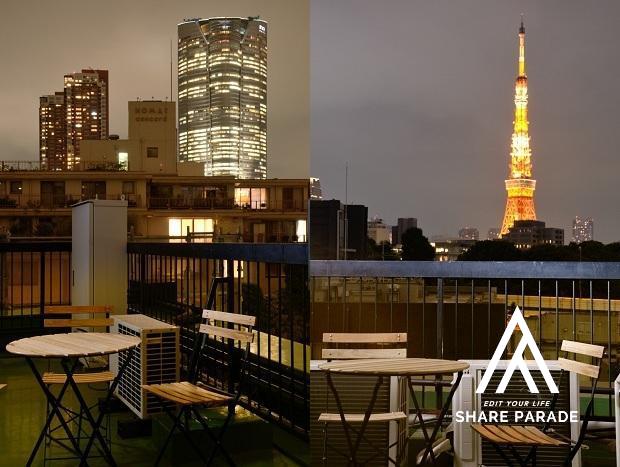
The shared areas include a spacious lounge, a large kitchen, bathrooms and shower rooms, a space suitable for remote work, an area for stretching and similar activities, and a rooftop terrace.
Every room has a balcony. The ability to eat, work, and relax outside your private room is a major difference from a studio apartment of around 20 m².
Furthermore, the ¥20,000 common service fee includes electricity, gas, water, shared household supplies, cleaning of the common areas, and other services.
In other words, FineMaison Ebisu’s “¥116,000 per month and above” does not mean the same thing as “¥116,000 in rent” at a standard rental apartment.
If you would like to compare properties other than FineMaison Ebisu, see the list of share houses around Ebisu Station.
To broaden your search, you can also view properties around Daikanyama and Shibuya in the list of share houses in Shibuya Ward.

The rent is ¥130,000, and the management and common service fees total ¥10,000. The fixed monthly housing cost is ¥140,000.
It has a 1K layout, a private floor area of 20.60 m², and is eight years old. It is a nine-minute walk from Ebisu Station on the JR Yamanote Line.
The security deposit is ¥130,000, and the non-refundable key money is ¥130,000.
After adding utilities and household supplies, the effective monthly cost under this comparison model is ¥154,833.
The property is located in Kamiosaki, Shinagawa Ward, rather than Shibuya Ward. This is an example of prioritizing a location within walking distance of Ebisu Station even when the address itself is not in Ebisu.

The rent is ¥183,000, with no management or common service fee. The private floor area is 29.58 m².
It is an eight-minute walk from Ebisu Station on the JR Yamanote Line and is 13 years old.
It is the largest of the four apartments compared here and provides enough space to accommodate a bed, desk, sofa, and other furniture comfortably.
However, the security deposit is ¥366,000, equivalent to two months’ rent, and the key money is ¥183,000.
After adding utilities and household supplies, the effective monthly cost is ¥197,833.

The rent is ¥125,000, and the management and common service fees total ¥20,000. The fixed monthly housing cost is ¥145,000.
It has a 1K layout, a private floor area of 20.02 m², and is 20 years old. It is a nine-minute walk from Ebisu Station on the Tokyo Metro Hibiya Line.
The security deposit is ¥125,000, and the key money is ¥125,000.
The advertised rent of “¥125,000” may stand out in a property search, but the total already reaches ¥145,000 once the management fee is added.
After utilities and household supplies are also included, the effective monthly cost under this model is ¥159,833.

The rent is ¥140,000, and the management and common service fees total ¥18,000. The fixed monthly housing cost is ¥158,000.
It has a studio layout, a private floor area of 20.45 m², and is nine years old. It is a five-minute walk from Ebisu Station on the JR Yamanote Line.
There is no key money, and the security deposit is ¥140,000.
After adding utilities and household supplies, the effective monthly cost is ¥172,833.
Even for an apartment of around 20 m², prioritizing proximity to the station and a newer building raises the actual monthly cost above ¥170,000.
This is where the true monthly comparison begins.
For FineMaison Ebisu, the monthly total is the rent plus the ¥20,000 common service fee.
For Studio Apartments A–D, ¥13,333 for utilities and ¥1,500 for household supplies are added to the rent and management or common service fees.
| Property | Rent and Management Fees | Separate Utilities and Household Supplies | Effective Monthly Cost | Difference from FineMaison |
|---|---|---|---|---|
| FineMaison Ebisu | Rent from ¥96,000 Common service fee of ¥20,000 |
Included in the common service fee | From ¥116,000 | - |
| Studio Apartment A | ¥140,000 | ¥14,833 | ¥154,833 | +¥38,833 |
| Studio Apartment B | ¥183,000 | ¥14,833 | ¥197,833 | +¥81,833 |
| Studio Apartment C | ¥145,000 | ¥14,833 | ¥159,833 | +¥43,833 |
| Studio Apartment D | ¥158,000 | ¥14,833 | ¥172,833 | +¥56,833 |
Swipe horizontally to view the full table
The effective monthly costs of Studio Apartments A–D range from ¥154,833 to ¥197,833.
The average across the four apartments is ¥171,333.
When FineMaison Ebisu is compared at ¥116,000 per month, the difference from the four-apartment average is ¥55,333 per month.
That amounts to approximately ¥664,000 over one year and approximately ¥1,328,000 over two years.
Even when a studio apartment is advertised at “¥140,000 in rent,” that is not the end of the monthly payments.
You must pay the management fee, electricity, gas, and water, and purchase your own toilet paper, detergent, and other household supplies.
When all these costs were included, the four apartments in this comparison cost nearly ¥155,000–¥198,000 per month.
By contrast, FineMaison Ebisu costs ¥116,000 per month, including the common service fee, at the lowest advertised rent. That fee even includes cleaning of the common areas.
The private room is not simply “cheaper.” Sharing part of everyday life reduces the fixed cost of living in Ebisu.
The figure of ¥13,333 is the 2025 average for one-person households. People who frequently work from home, use air conditioning for long periods, or regularly take baths may spend more. Conversely, people who are often away from home may spend less.
The ¥1,500 household-supply expense is also a comparison model. Actual spending varies from person to person.
For FineMaison Ebisu’s common service fee, please confirm the latest included items and conditions of use when signing your contract.
In addition to the monthly costs, we will compare the amount of cash required when moving in.
Under the advertised conditions, FineMaison Ebisu requires a ¥30,000 deposit and a ¥10,000 fire insurance premium.
Using the lowest advertised rent of ¥96,000 and the ¥20,000 common service fee, the estimated payment at the start of the contract is approximately ¥156,000.
Studio Apartments A–D cannot be rented by paying only the security deposit and key money displayed on their listing pages.
For comparison purposes, we therefore created a model that also includes the brokerage fee, the rent guarantee company’s initial fee, fire insurance, and the lock replacement fee.
| Property | Security Deposit | Key Money | Estimated Payment at the Start of the Contract | Difference from FineMaison |
|---|---|---|---|---|
| FineMaison Ebisu | ¥30,000 deposit | - | Approximately ¥156,000 | - |
| Studio Apartment A | ¥130,000 | ¥130,000 | Approximately ¥655,000 | +Approximately ¥499,000 |
| Studio Apartment B | ¥366,000 | ¥183,000 | Approximately ¥1,066,800 | +Approximately ¥910,800 |
| Studio Apartment C | ¥125,000 | ¥125,000 | Approximately ¥647,000 | +Approximately ¥491,000 |
| Studio Apartment D | ¥140,000 | - | Approximately ¥573,000 | +Approximately ¥417,000 |
Swipe horizontally to view the full table
For the four studio apartments in this comparison, the estimated payment required at the start of the contract ranges from approximately ¥570,000 to ¥1.07 million.
The difference compared with FineMaison Ebisu ranges from approximately ¥420,000 to ¥910,000.
Even if you would like to live in Ebisu at least once, a standard rental apartment requires a substantial amount of cash before you can move in.
Furthermore, if you do not already own a bed, refrigerator, washing machine, desk, curtains, and other essential items, you will also need to purchase furniture and appliances.
Actual contract costs vary depending on such factors as a waived brokerage fee, different guarantee-fee rates, lock replacement fees, cleaning fees, and 24-hour support services.
Part or all of a security deposit or deposit may be refunded when you move out. Here, these amounts are compared as “cash that must be prepared when moving in.”
Setting upfront costs aside for the moment, we compare the effective monthly costs over 24 months.
| Property | Effective Monthly Cost | 24 Months | Difference from FineMaison |
|---|---|---|---|
| FineMaison Ebisu | From ¥116,000 | From ¥2,784,000 | - |
| Studio Apartment A | ¥154,833 | ¥3,715,992 | +¥931,992 |
| Studio Apartment B | ¥197,833 | ¥4,747,992 | +¥1,963,992 |
| Studio Apartment C | ¥159,833 | ¥3,835,992 | +¥1,051,992 |
| Studio Apartment D | ¥172,833 | ¥4,147,992 | +¥1,363,992 |
Swipe horizontally to view the full table
Even Studio Apartment A, which has the smallest difference, costs approximately ¥930,000 more over two years.
The average difference across the four apartments is approximately ¥1,328,000.
Of course, this does not mean that choosing a share house will automatically “save you ¥1.33 million.”
In a studio apartment, the additional amount pays for a private kitchen, private bathroom, private toilet, and complete privacy.
At a share house, you share some of these facilities in exchange for lower housing costs, spacious common areas, and cleaning services.
The question is which facilities you are willing to pay to keep entirely for yourself.
In Ebisu, however, the price difference between those choices is considerable.
If living in a share house leaves you with approximately ¥1 million more over two years, it can change your options for dining out, travel, education, hobbies, savings, and your life as a whole.
Studio Apartments A–D in this comparison range from 20.02 to 29.58 m².
Looking only at the figures, they may appear larger than a private room in a share house.
However, that private floor area also includes the entrance, kitchen, bathroom, toilet, corridor, and storage.
In a 1K apartment of around 20 m², the actual room in which you place your bed and desk may be only six to seven tatami mats, or approximately 9.7–11.3 m².
Private rooms at FineMaison Ebisu are more compact than a standard studio apartment of around 20 m².
In return, the functions of daily life can be distributed throughout the building: meals in the large kitchen and lounge, work in the workspace, and breaks on the rooftop terrace or in the stretching area.
Instead of treating “home” as only the area inside your room, this lifestyle uses the “private room plus shared areas” as your home.
In a studio apartment, you can use your own kitchen whenever you like.
This is a major benefit that a share house cannot provide.
However, some studio apartments of around 20 m² have a small cooktop and sink, with almost no space for food preparation.
At FineMaison Ebisu, the kitchen is shared, but residents can use a large kitchen designed for use by multiple people.
Choose a studio apartment if you want to cook without having to consider anyone else. Choose a share house if you want to use a large kitchen even though it is not exclusively yours.
This point is more important than the difference in rent.
If sharing bathrooms and toilets with other people would itself be stressful, you will probably be more satisfied with a studio apartment even if it costs tens of thousands of yen more each month.
Conversely, some people do not mind sharing wet-area facilities as long as they have their own private room.
For those people, a monthly difference of ¥40,000, ¥50,000, or ¥80,000 in Ebisu is likely to be extremely significant.
In a studio apartment, you clean not only the living space but also the kitchen, bathroom, toilet, and washbasin yourself.
At FineMaison Ebisu, residents manage their own private rooms, but the common areas are professionally cleaned.
No professional cleaning service fee has been added to the studio apartments in this comparison.
Therefore, the monetary comparison does not yet include the value of the common-area cleaning service.
In a 20 m² studio apartment, you are likely to sleep, eat, and work in the same room.
At FineMaison Ebisu, you can use a workspace separate from your private room.
Even if the private floor area is smaller, being able to separate work from everyday life has value that cannot be measured solely in square meters.
When people consider ways to reduce rent, they often think about living farther from the station, compromising on the age of the building, or choosing a smaller room.
However, there is another option.
You can share the parts of a home that you do not necessarily need to have entirely to yourself, such as the kitchen, bathrooms, and lounge.
If your reasons for wanting to live in Ebisu are the neighborhood itself, its restaurants, convenient transportation, ways to spend your days off, and ease of commuting, you do not need to give up on the location solely because of the size of your private room.
In this article, we compared Studio Apartments A–D within a 10-minute walk of Ebisu Station with FineMaison Ebisu.
The rent and management fees for Studio Apartments A–D range from ¥140,000 to ¥183,000.
However, that does not represent the full cost of everyday living.
After adding ¥13,333 for electricity, gas, and water and ¥1,500 for household supplies, the effective monthly cost is approximately ¥154,800–¥197,800. The average is approximately ¥171,300.
FineMaison Ebisu’s advertised rent is ¥96,000–¥129,000, plus a ¥20,000 common service fee.
At the lowest advertised rent, the total is ¥116,000 per month, and the common service fee includes electricity, gas, water, shared household supplies, cleaning of the common areas, and other services.
The average difference compared with Studio Apartments A–D is approximately ¥55,300 per month.
That amounts to approximately ¥664,000 over one year and approximately ¥1,328,000 over two years.
In exchange for this difference, a studio apartment provides a private kitchen, private bathroom, private toilet, and complete independence.
A share house provides lower housing costs, lower upfront costs, large shared spaces separate from the private room, and services such as cleaning of the common areas.
Neither option is absolutely superior to the other.
However, in Ebisu, the cost of having everything entirely to yourself is particularly high.
Tokyo Is Too Expensive for Living Alone.
Ebisu is a neighborhood where that reality is especially clear.
Even so, you do not have to conclude, “Ebisu is too expensive, so I must give up on living there.”
Choose a studio apartment if completely independent living is essential.
Choose a share house if you can accept sharing wet-area facilities in exchange for the location of Ebisu, spacious shared areas, lower upfront costs, and lower monthly fixed expenses.
Before closing a property-search page after seeing rents of ¥150,000, ¥160,000, or ¥180,000 and deciding that Ebisu is beyond your budget, try searching once more after reconsidering the type of home itself.
Compare Ways of Living in Ebisu Other Than a Studio Apartment
Search for share houses around Ebisu Station on a map
I Want to Search Around Ebisu Station
Compare properties while checking their actual locations in relation to Ebisu Station on a map.
I Want to Expand My Search Throughout Shibuya Ward
For people who want to expand their options beyond Ebisu to include Shibuya and Daikanyama.
I Prioritize Spacious Common Areas
Large properties with at least 30 residents. Some feature expansive lounges and multiple shared facilities.
I Want Both a Large Property and Wet-Area Facilities in My Private Room
For people who want to use large-scale common areas while also prioritizing wet-area facilities in their private rooms.
I Want Wet-Area Facilities for My Own Use
Some share houses provide a toilet, shower, washbasin, or other wet-area facilities inside the private room.
I Want a Home Suited to Working Remotely
Compare properties with spaces separate from the private rooms where residents can concentrate on work or study.
I Want to Use a Spacious Kitchen
For people who prioritize the number of cooktops, food-preparation space, and other features of the shared kitchen.
I Want to Move In Without Purchasing Furniture and Appliances
Compare private rooms furnished with beds, desks, storage, and other essential items.
Main Data and Comparison Conditions Used in This Article
・LIFULL HOME'S “Average Rents Around Ebisu Station”: ¥161,400 for a studio, ¥156,900 for a 1K, ¥217,300 for a 1DK, and ¥302,800 for a 1LDK
・Statistics Bureau of Japan, “Family Income and Expenditure Survey: Income and Expenditure, One-Person Households (2025)”: ¥13,333 per month for fuel, light, and water charges
・Household supplies: A comparison model of ¥1,500 per month for toilet paper, hand soap, dishwashing detergent, sponges, garbage bags, and similar items
・SUUMO: Listing information for Studio Apartments A–D compared in this article
・SHARE PARADE: Rent, common service fees, number of rooms, access, upfront costs, and other information for FineMaison Ebisu
※Rent, common service fees, vacancies, and upfront costs are subject to change. Please confirm the latest conditions when reading the published article.
※The upfront costs for the studio apartments are a comparison model based on the conditions described in this article and may differ from actual quotations.
※Internet charges are not included in this effective monthly cost comparison because it is difficult to standardize the contract conditions of all properties.
※No professional cleaning service fee has been added to the studio apartments. Residents are generally assumed to clean their own apartments.
Q. What is the average rent for a studio apartment near Ebisu Station?
A. According to LIFULL HOME'S data as of August 2026, the average rent for a studio apartment within a 10-minute walk of Ebisu Station is approximately ¥161,400. The average is approximately ¥156,900 for a 1K, ¥217,300 for a 1DK, and ¥302,800 for a 1LDK.
Q. Is a ¥20,000 share house common service fee the same as a ¥20,000 management fee for a studio apartment?
A. No. FineMaison Ebisu’s common service fee includes electricity, gas, water, shared household supplies, cleaning of the common areas, and other services. A studio apartment’s management fee is primarily used to maintain the building’s common areas, while utilities and daily necessities used inside the apartment generally cost extra.
Q. Approximately how much does a studio apartment in Ebisu cost each month when expenses other than rent are included?
A. For Studio Apartments A–D compared here, adding ¥13,333 for utilities and ¥1,500 for household supplies to the rent and management fees resulted in effective monthly costs of approximately ¥154,800–¥197,800.
Q. How much does FineMaison Ebisu cost per month?
A. The rent advertised on SHARE PARADE ranges from ¥96,000 to ¥129,000, with a ¥20,000 common service fee. At the lowest advertised rent, the total is ¥116,000. Actual rent for vacant rooms varies depending on the time of application.
Q. How much difference does choosing a share house in Ebisu make?
A. The average effective monthly cost of Studio Apartments A–D in this comparison is approximately ¥171,300, while FineMaison Ebisu costs ¥116,000 per month at the lowest advertised rent. The difference is approximately ¥55,300 per month. Over two years, the average difference in monthly living costs alone amounts to approximately ¥1,328,000.
Q. I want to live in Ebisu, but rent above ¥150,000 feels too expensive. How should I search?
A. In addition to compromising on distance from the station or building age, you can change the type of housing you consider by including share houses in your search. Comparing share houses around Ebisu Station and share houses in Shibuya Ward alongside standard rental apartments may help you find an option that reduces your housing expenses while keeping Ebisu within your everyday living area.

SHARE PARADE(シェアパレード) の運営責任者です。「EDIT YOUR LIFE ― 今の暮らしをちょっと変えてみる」を合言葉に、**コミュニティのある暮らし(Community Living)**を中心としたシェアハウスを紹介しています。2011年の立ち上げ以来、東京全域で800件以上を現地取材。私自身も一人暮らし/シェアハウス/ルームシェア/ソーシャルマンションを一通り経験しており、一次情報と体験の両方を基準にサイトを運営しています。「住む場所が変われば、ライフスタイルも変わる」。コミュニティがある暮らしの楽しさと安心を、もっと当たり前の選択肢に――それがSHARE PARADEの役割であり、私のミッションです。 I am the administrator of the website 'SHARE PARADE.' Under the motto “EDIT YOUR LIFE—make a small change to your everyday,” we feature share houses centered on community living. Since our launch in 2011, I have visited and reviewed more than 800 properties across Tokyo. I’ve personally experienced living alone, in share houses, in room shares, and in social apartments, and I run the site based on both first-hand information and lived experience. I believe that when your home changes, your lifestyle changes too. My mission—and SHARE PARADE’s role—is to make the joy and peace of mind of community living a more everyday choice.
![[10 Examples] Share House Trouble Cases and Prevention Tips to Know Before Moving In](https://sharepare.jp/upload_images/contents/202607/20260716_6a5861b26b7f20engi7.png "[10 Examples] Share House Trouble Cases and Prevention Tips to Know Before Moving In")