When comparing a share house and a studio apartment, it is easy to look only at “which one is cheaper.”
However, when it comes to actually living there, the matter is not quite so simple.
In a studio apartment, the kitchen and bathroom are exclusively yours. In exchange, with the same budget, the room may be smaller, farther from the station, or in an older building.
In a share house, the water facilities are shared, but some properties allow you to use a spacious kitchen, lounge, and workspace in addition to your own private room. The cost of obtaining furniture and the burden of cleaning the common areas can also be reduced.
Therefore, this time, we will use Nakanobu Station as an example. It offers a good balance between transportation and shopping convenience within Tokyo and is easy to consider as a candidate area for living alone.
We placed one currently available share house alongside three studio apartment rentals located within a 5-minute walk of the station and built within the past 10 years, and compared rent, size, initial costs, utilities, kitchens, bathrooms, lounges, and cleaning services.
Let us examine the differences between living arrangements in the same neighborhood that cannot be seen from images such as “share houses are cheap” and “studio apartments offer freedom” alone.
〇This Time, We Compare Properties in the Convenient Nakanobu Area
〇Studio Apartment Rent Market Around Nakanobu Station
〇The Four Actual Properties and Conditions Compared
〇Share House | FineMaison Shinagawa Nakanobu
〇Characteristics of the Three Studio Apartment Rentals
〇Comparison Including Utilities, Communication Costs, and Supplies
〇Comparing the Total Cost Over Two Years
〇Differences in Size, Kitchens, Bathrooms, and Shared Facilities
〇Which Is More Suitable, a Share House or a Studio Apartment?
〇The Idea of Putting the Housing-Cost Savings Into NISA Investments
We selected Nakanobu this time because it combines convenient access to central Tokyo with ease of daily living, making it an easy neighborhood to use for comparison by people considering living alone in Tokyo.
At Nakanobu Station, you can use two train lines: the Toei Asakusa Line and the Tokyu Oimachi Line. The Asakusa Line provides convenient access toward Gotanda, Shimbashi, and Nihombashi, while the Oimachi Line takes you toward Oimachi, Jiyugaoka, and Futako-Tamagawa.
Near the station is “Nakanobu Skip Road,” an approximately 300-meter-long covered shopping arcade. Supermarkets, drugstores, restaurants, and traditional independent shops are concentrated there, creating an environment where shopping on the way home from work is easy.
While the area in front of the station is highly convenient, it has less of the noise found in major entertainment districts, and a short walk takes you into residential neighborhoods.
It is a well-balanced location for people who think, “I want to reduce my commuting time, but living in a crowded entertainment district even on my days off would be tiring.”
Before comparing the actual properties, let us check the rent market around Nakanobu Station.
According to market figures calculated from property data listed on LIFULL HOME'S, the monthly rent around Nakanobu Station is 103,500 yen for a studio apartment, 110,600 yen for a 1K, and 121,800 yen for a 1DK.
| Floor Plan | Rent Market Around Nakanobu Station | How to Interpret the Market Figure |
|---|---|---|
| Studio Apartment | 103,500 yen | For a single person, with the living area and kitchen combined |
| 1K | 110,600 yen | The living area and kitchen can be separated by a door |
| 1DK | 121,800 yen | It is easier to secure a separate dining space |
| Average for Studio Apartments, 1K, and 1DK | 109,600 yen | A guideline for single-person properties within a 10-minute walk of the station |
The table can be scrolled horizontally
Because these market rents do not include management fees or common service fees, the actual monthly payment may be several thousand yen to approximately 15,000 yen higher.
By size, property data listed by Housecom shows an average of 80,000 yen for units under 20㎡ and 116,000 yen for units measuring 20 to 30㎡.
| Exclusive Floor Area | Average Rent | Image of Daily Living |
|---|---|---|
| Under 20㎡ | 80,000 yen | It is easier to keep rent low, but the living area and storage tend to be smaller |
| 20–30㎡ | 116,000 yen | It is easier to secure a certain degree of space when living alone |
| 30–40㎡ | 153,000 yen | There is greater flexibility in furniture placement and working from home |
The table can be scrolled horizontally
LIFULL HOME'S market figures by floor plan are calculated from listed properties within a 10-minute walk of the station and do not include management fees or similar charges. Housecom’s market figures by size are also averages of the rents for currently listed properties.
Prices vary significantly depending on the age of the building, distance from the station, whether the property is an apartment building or a smaller rental building, and the available facilities. The market figure does not mean that a property can always be rented for that amount; it is a guideline for determining whether the actual properties compared this time are expensive or inexpensive.
The properties compared this time are one share house and three studio apartment rentals located within a 5-minute walk of Nakanobu Station and available at the time of recruitment in July 2026.
The studio apartments were all limited to buildings constructed within the past 10 years.
FineMaison Shinagawa Nakanobu, on the other hand, was originally constructed in 1992. However, it underwent a large-scale renovation in 2025 and began operating as a share house in the same year.
In other words, this is not a simple comparison between “newer properties and newer properties.”
We are comparing newer studio apartments in which all water facilities are exclusively private with a share house created by extensively renovating an existing building and concentrating facilities in common areas.
| Property | Amount Used for Rent Comparison | Size | Construction Year and Renovation | Main Characteristics |
|---|---|---|---|---|
| FineMaison Shinagawa Nakanobu | 77,000 yen | 16.2㎡ | Built in 1992 Large-scale renovation and start of operations in 2025 |
Private room with washstand, large lounge, and workspace |
| Studio Apartment A | 105,000 yen | 13.68㎡ | Built in February 2025 | Newest property in this comparison, no security deposit or key money |
| Studio Apartment B | 118,000 yen | 20.53㎡ | Built in January 2022 | 1K, over 20㎡, no security deposit or key money |
| Studio Apartment C | 138,000 yen | 25.01㎡ | Built in June 2019 | Largest property in this comparison, management fee of 2,000 yen |
The table can be scrolled horizontally
For the share house, only the private-room rent is used. For the studio apartments, the total of the rent and management fee is treated as the “amount used for rent comparison.”
The share house’s 20,000-yen common service fee differs in content from the management fee of a standard rental property. Because it includes electricity, gas, water, internet, shared supplies, and cleaning of common areas, it is compared separately as a living expense in the next section.
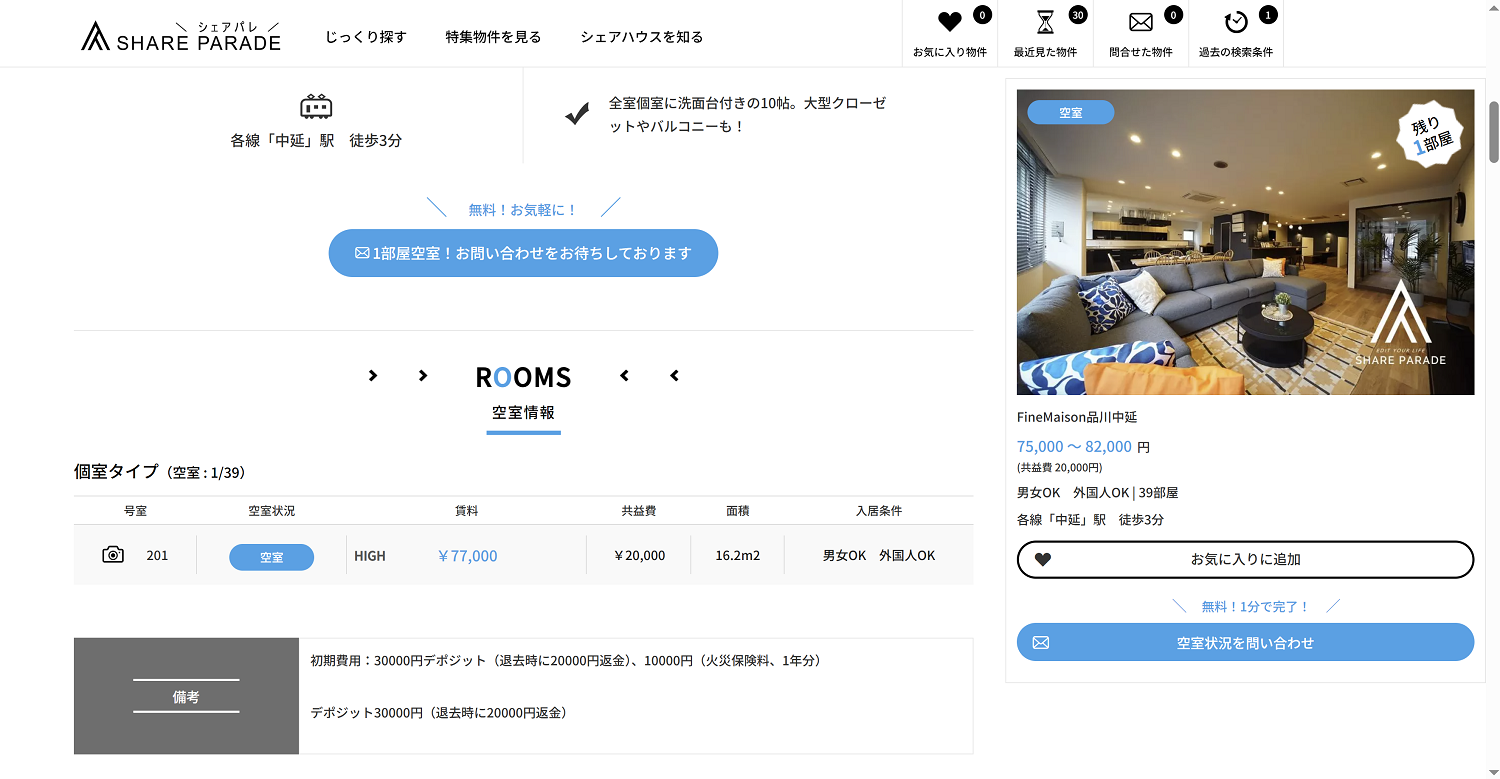
It is approximately a 3-minute walk from Nakanobu Station on the Toei Asakusa Line and approximately a 4-minute walk from Nakanobu Station on the Tokyu Oimachi Line. It is a large share house with 39 rooms in total.
Room 201, which was used for the comparison based on the listing at the time, had a private-room rent of 77,000 yen, a common service fee of 20,000 yen, and an area of 16.2㎡.
The private room measures 10 tatami mats and is equipped with a washstand, large closet, bed, desk, chair, refrigerator, and other items.
The common areas include an LDK measuring more than 57 tatami mats, a large kitchen, sofa area, booth seating, workspace, and fitness room.
The bathroom, shower rooms, toilets, kitchen, and washing machines are shared. However, because there is a washstand inside the private room, residents do not need to enter the common area every time they brush their teeth or prepare themselves in the morning.
Although the building was constructed in 1992, it underwent a large-scale renovation in 2025 and began operating as a share house.
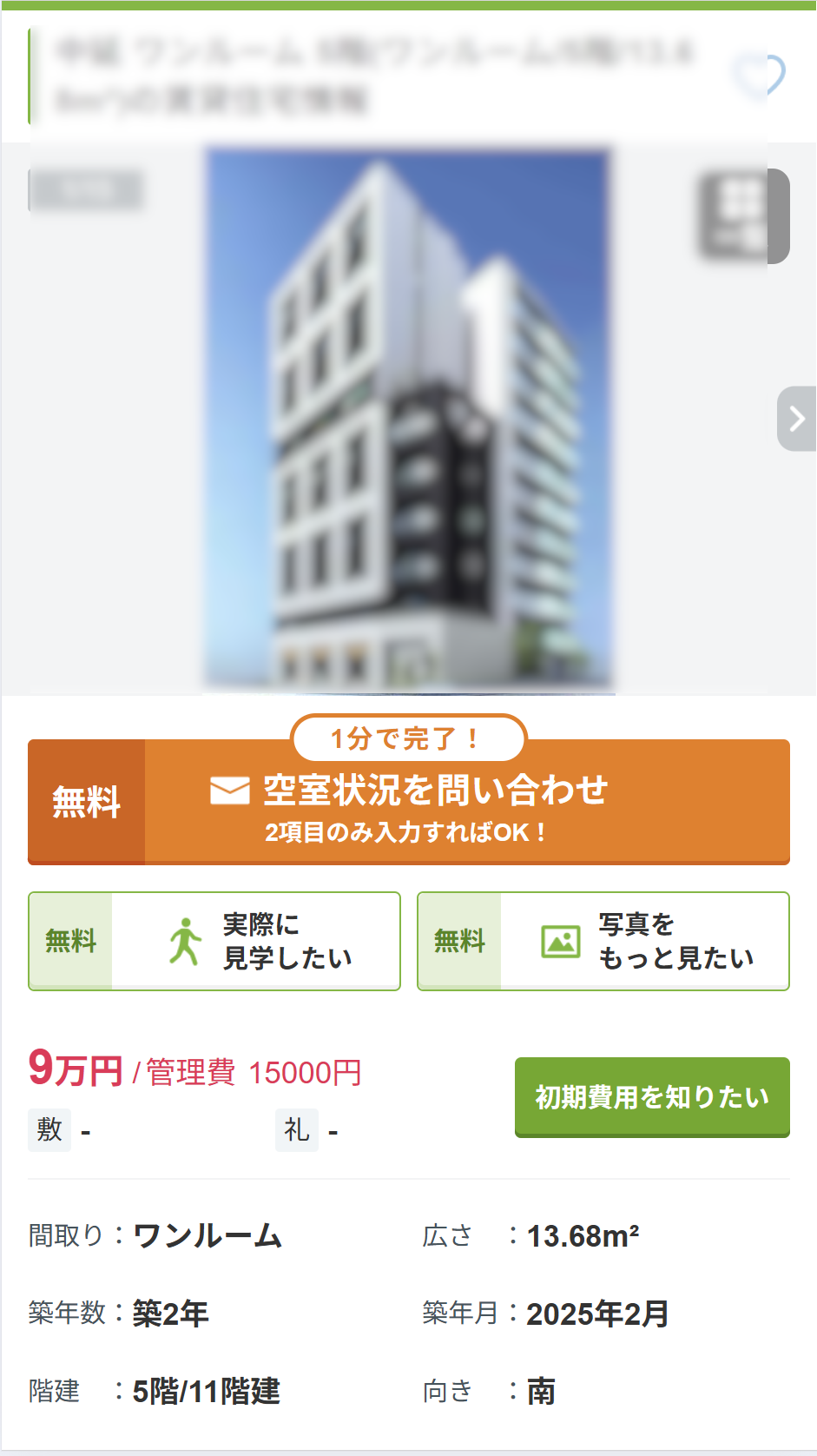
The rent is 90,000 yen and the management fee is 15,000 yen, making the monthly payment 105,000 yen.
Although it is new, having been built in February 2025, the exclusive floor area is 13.68㎡. It is approximately 2.5㎡ smaller than the private room at FineMaison Shinagawa Nakanobu.
However, a private kitchen, bathroom, toilet, and other facilities are all contained within the 13.68㎡.
It is suitable for people who prioritize a nearly new building and complete privacy over the size of the room.
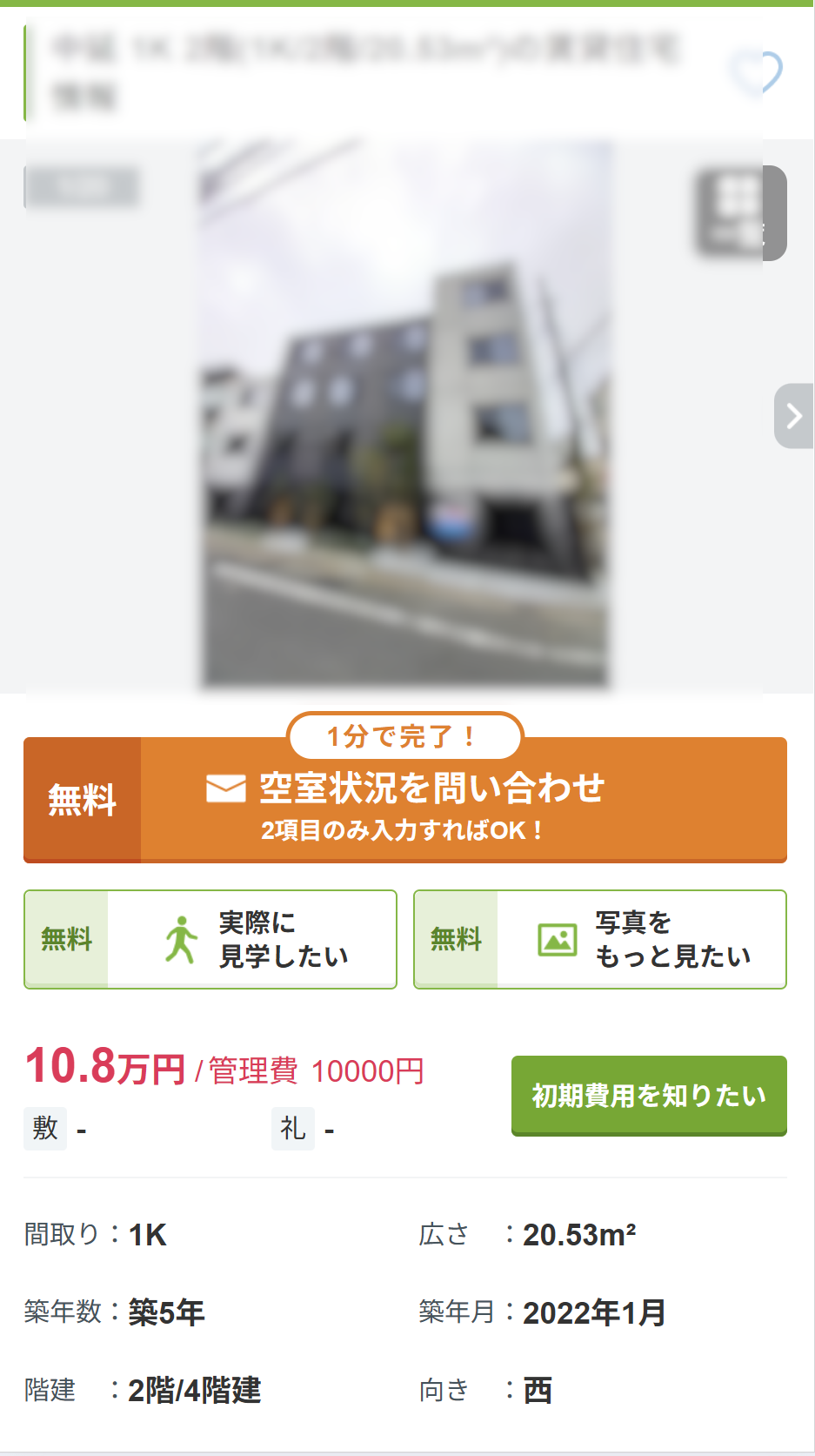
The rent is 108,000 yen and the management fee is 10,000 yen, making the monthly payment 118,000 yen.
The exclusive floor area is 20.53㎡. Because the floor plan is a 1K, the entrance and kitchen can be separated from the living area by a door.
It is larger than the private room at FineMaison Shinagawa Nakanobu and also provides private water facilities.
It is suitable for people who want to avoid an extremely small room while maintaining the independence associated with living alone.
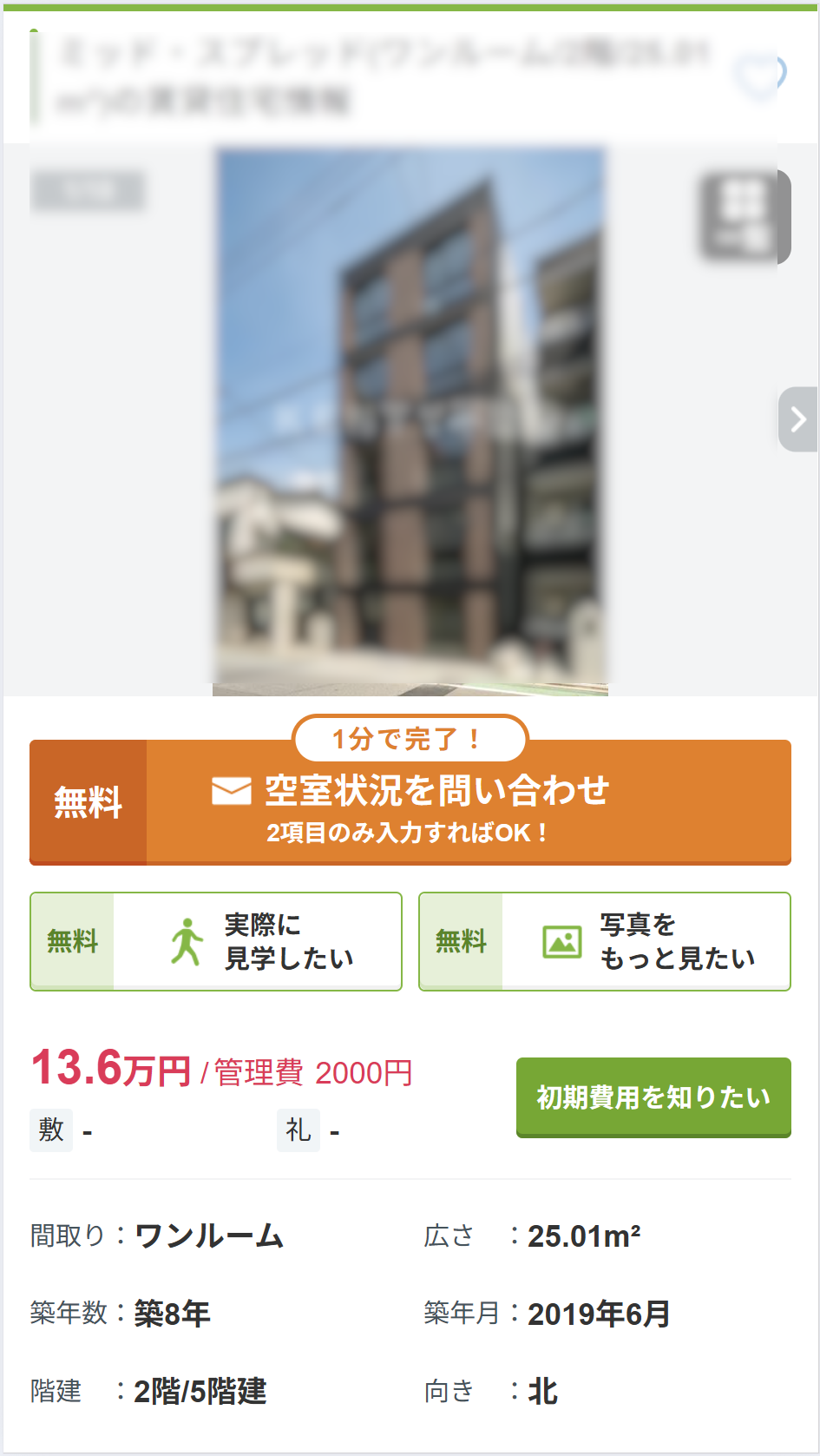
The rent is 136,000 yen and the management fee is 2,000 yen, making the monthly payment 138,000 yen.
The exclusive floor area is 25.01㎡. Among the properties compared this time, it offers the largest private space.
It is easy to place a bed, desk, sofa, and other furniture, and the size is also suitable for people who work from home or have many belongings.
In exchange, the monthly difference compared with the private-room rent at FineMaison Shinagawa Nakanobu is 61,000 yen.
First, we will compare the amount paid to the property itself each month.
For the share house, this is only the private-room rent. For the studio apartments, it is the combined total of the rent and management fee.
| Property | Amount Used for Rent Comparison | Difference From FineMaison |
|---|---|---|
| FineMaison Shinagawa Nakanobu | 77,000 yen | - |
| Studio Apartment A | 105,000 yen | +28,000 yen |
| Studio Apartment B | 118,000 yen | +41,000 yen |
| Studio Apartment C | 138,000 yen | +61,000 yen |
The table can be scrolled horizontally
Looking only at rent, there is a monthly difference of 28,000 yen even between the share house and the least expensive studio apartment.
However, it is too early to conclude here that “the share house costs 77,000 yen and the studio apartment costs 105,000 yen.”
FineMaison Shinagawa Nakanobu has a 20,000-yen common service fee, while the studio apartments separately require utility costs, internet charges, and household-supply costs.
In the previous comparison, the combined cost of utilities and internet for a studio apartment was set at 14,000 yen per month.
However, that figure is somewhat low for the current cost burden of living alone.
Based on the Ministry of Internal Affairs and Communications’ 2025 Family Income and Expenditure Survey, average monthly utility costs for single-person households are 13,333 yen.
Adding 4,000 yen per month for home internet and 1,500 yen per month for expenses equivalent to shared supplies such as toilet paper, hand soap, dishwashing detergent, sponges, and garbage bags brings the total to approximately 18,800 yen.
For clarity, the comparison table uses 19,000 yen per month.
| Expense | Monthly Model | Details |
|---|---|---|
| Electricity, Gas, and Water | 13,333 yen | Uses the 2025 average for single-person households |
| Home Internet | 4,000 yen | Model based on a fixed-line connection or home router |
| Household Supplies | 1,500 yen | Toilet paper, hand soap, dishwashing detergent, sponges, garbage bags, and more |
| Total | Approximately 19,000 yen | Smartphone charges are excluded because they are necessary in both cases |
The 20,000-yen common service fee at FineMaison Shinagawa Nakanobu includes electricity, gas, water, and internet, as well as supplies used in the common areas, such as toilet paper, hand soap, and dishwashing detergent, together with regular cleaning of the common areas.
In other words, the 20,000-yen common service fee is not the same as the “management fee for building management” charged at a standard rental property.
It combines the cost of living infrastructure and supplies that would be paid individually in a studio apartment with cleaning services for the common areas.
| Property | Rent, Management Fees, etc. | Utilities, Communication, and Supplies | Effective Monthly Burden |
|---|---|---|---|
| FineMaison Shinagawa Nakanobu | Rent: 77,000 yen Common service fee: 20,000 yen |
Included in the common service fee | 97,000 yen |
| Studio Apartment A | 105,000 yen | Approximately 19,000 yen | Approximately 124,000 yen |
| Studio Apartment B | 118,000 yen | Approximately 19,000 yen | Approximately 137,000 yen |
| Studio Apartment C | 138,000 yen | Approximately 19,000 yen | Approximately 157,000 yen |
The table can be scrolled horizontally
When compared using amounts closer to actual living expenses, the difference between FineMaison Shinagawa Nakanobu and Studio Apartment A is approximately 27,000 yen per month.
The difference is approximately 40,000 yen compared with Studio Apartment B and approximately 60,000 yen compared with Studio Apartment C.
People who frequently work from home, use air conditioning for long periods, or regularly soak in the bathtub may exceed the average. Conversely, people who are often away from home and rarely cook may fall below the average.
The items included in a share house’s common service fee and any usage limits also vary by property. Check the contract conditions before moving in.
In addition to the difference in monthly rent, let us also compare the cash required when moving.
At FineMaison Shinagawa Nakanobu, the following expenses can be assumed based on the listed conditions at the time of comparison.
Of the 30,000-yen deposit, 20,000 yen is refundable when moving out under the stated conditions.
The three studio apartments require no security deposit or key money, but brokerage fees, guarantor-company fees, fire insurance, key-replacement fees, and other charges may still apply.
This time, the model calculation uses the following conditions.
| Property | Estimated Payment at the Start of the Contract | Difference From FineMaison |
|---|---|---|
| FineMaison Shinagawa Nakanobu | 137,000 yen | - |
| Studio Apartment A | 298,500 yen | +161,500 yen |
| Studio Apartment B | 337,800 yen | +200,800 yen |
| Studio Apartment C | 398,600 yen | +261,600 yen |
The table can be scrolled horizontally
Even for properties with no security deposit or key money, the initial cost of a studio apartment is approximately 300,000 to 400,000 yen.
Furthermore, if you do not already own curtains, a bed, desk, lighting, refrigerator, washing machine, microwave, and other items, you will also need to purchase furniture and appliances.
FineMaison Shinagawa Nakanobu has furniture and a refrigerator in each private room, while washing machines, dryers, and other appliances are available as shared facilities.
In an actual contract, guarantor-company charges, key-replacement fees, fire insurance, cleaning fees, 24-hour support fees, administrative charges, and other costs will vary.
Even when a listing states “no security deposit or key money,” the total initial cost is not necessarily low. Always confirm the total amount in a written estimate.
We calculate the approximate cost of living in each property for two years by combining the payment at the start of the contract with the effective monthly burden.
Because the initial cost includes the first month’s payment, the monthly expenses for the remaining 23 months are added.
| Property | Effective Monthly Cost | At the Start of the Contract | Approximate Two-Year Total |
|---|---|---|---|
| FineMaison Shinagawa Nakanobu | 97,000 yen | 137,000 yen | 2,368,000 yen |
| Studio Apartment A | Approximately 124,000 yen | 298,500 yen | Approximately 3,150,500 yen |
| Studio Apartment B | Approximately 137,000 yen | 337,800 yen | Approximately 3,488,800 yen |
| Studio Apartment C | Approximately 157,000 yen | 398,600 yen | Approximately 4,009,600 yen |
The table can be scrolled horizontally
Compared with FineMaison Shinagawa Nakanobu, the difference is approximately 780,000 yen for Studio Apartment A, approximately 1.12 million yen for Studio Apartment B, and approximately 1.64 million yen for Studio Apartment C.
These are considerable differences, but this does not mean that “a share house provides the same lifestyle at a lower price.”
In a studio apartment, you can secure your own private kitchen, bathroom, toilet, and washing-machine space.
In a share house, you share those facilities in exchange for lower costs and access to spacious common areas that could not be included within a private room alone.
| Property | Exclusive Floor Area | What Is Included in the Area |
|---|---|---|
| FineMaison Shinagawa Nakanobu | 16.2㎡ | Living area, washstand, storage, and more |
| Studio Apartment A | 13.68㎡ | Living area, entrance, kitchen, bathroom, toilet, and more |
| Studio Apartment B | 20.53㎡ | Living area, kitchen, water facilities, and more |
| Studio Apartment C | 25.01㎡ | Living area, kitchen, water facilities, and more |
The table can be scrolled horizontally
The 13.68㎡ of a studio apartment includes the entrance, kitchen, bathroom, and toilet.
Because the 16.2㎡ private room at FineMaison Shinagawa Nakanobu does not include an in-room kitchen or bathroom, a greater proportion of the area can be used as living and storage space.
The fact that a unit has a certain exclusive floor area does not necessarily mean that there is a large amount of space available for placing a bed or desk. This should be checked during the viewing.
The kitchen in a studio apartment can be used whenever you wish.
You can leave dishes and seasonings in place and do not need to consider whether other residents are using the kitchen.
On the other hand, compact studio apartments may have only a single-burner stove and a small sink. It is not unusual for there to be almost no cooking space on which to place a cutting board.
At FineMaison Shinagawa Nakanobu, the kitchen is shared, but residents can use four large kitchen areas.
Although there are rules concerning busy periods and cleaning up, the amount of cooking space and equipment is more substantial than in a 13–20㎡ studio apartment.
For people who rarely cook, having more living space may suit them better than using part of their private room for a small kitchen.
This is an area in which preferences are more clearly divided than they are by the difference in cost.
At FineMaison Shinagawa Nakanobu, the bathroom, shower rooms, and toilets are shared.
Cleaning is carried out approximately three times per week, but you may need to use the facilities immediately after someone else, and they may become crowded at certain times of day.
If you are uncomfortable with sharing water facilities itself, choosing a studio apartment may create less daily stress, even if the monthly burden is higher.
Conversely, if you are comfortable having a washstand inside your private room and sharing only the bathing and toilet facilities, it becomes easier to benefit from the share house’s cost advantages.
A studio apartment generally offers no place to spend time other than your own room.
In a 13.68㎡ room, once a bed and desk are placed, eating, working, and relaxing will all take place in almost the same location.
At FineMaison Shinagawa Nakanobu, residents can use an LDK measuring more than 57 tatami mats, a sofa area, booth seating, a workspace, and a fitness room.
Even though the private room measures 16.2㎡, the places used for working, eating, and relaxing can be separated.
For people who work from home, this is a benefit that cannot be measured by exclusive floor area alone.
In a studio apartment, you clean not only the living area but also the kitchen, bathroom, toilet, and washstand yourself.
In a share house, you still clean your own private room, but the common areas receive regular cleaning.
At FineMaison Shinagawa Nakanobu, the common areas are cleaned by the manager approximately three times per week.
Of course, everyday responsibilities are still necessary, such as returning used dishes, lightly wiping areas you have dirtied, and following the garbage-disposal rules.
Even so, the burden of maintaining the bathroom and toilet entirely by yourself is reduced.
The three studio apartments were built within the past 10 years.
In contrast, the FineMaison Shinagawa Nakanobu building was constructed in 1992, but underwent a large-scale renovation in 2025.
While the studio apartments are newer in terms of construction year, the share house provides more extensive facilities throughout the building, including a lounge and workspace.
Do you want to live in a newer building, or would you prefer an existing building with renewed interiors and common facilities, together with more usable spaces?
This point also needs to be determined by viewing the actual condition of the property, rather than from figures alone.
In this comparison, the effective monthly difference between FineMaison Shinagawa Nakanobu and the studio apartments was approximately 27,000 to 60,000 yen.
When rent decreases, spending on dining out and shopping may increase, leaving nothing in your hands in the end.
One method is to direct part of the saved amount into savings or NISA investments from the beginning.
Some residents regard choosing a share house not only as a way “to live cheaply this month,” but also as a way “to increase the amount of money available for future asset building.”
The following article introduces how actual residents think about reducing housing costs and creating funds for NISA and stock investments.
Of course, investments carry the possibility of losing principal. Secure emergency living funds first, and consider investing only within a reasonable range.
This time, using the convenient Nakanobu Station area as an example, we compared one share house with three studio apartment rentals built within the past 10 years.
The private-room rent at FineMaison Shinagawa Nakanobu is 77,000 yen.
The three studio apartments cost between 105,000 and 138,000 yen when rent and management fees are combined.
Considering that the market rent for a studio apartment around Nakanobu Station is approximately 103,500 yen, regardless of distance from the station, even Studio Apartment A, the least expensive option, is not significantly outside the market range.
Even so, when utilities, internet, and supplies are included, the effective monthly burden differs from FineMaison Shinagawa Nakanobu by approximately 27,000 to 60,000 yen.
What a studio apartment provides in exchange for this difference is a private kitchen, private bathroom, private toilet, and freedom concerning daily schedules and visitors.
What the share house provides is lower initial costs, a furnished private room, a spacious kitchen, a lounge, a workspace, and cleaning of common areas.
Rather than one being superior to the other, they differ in what you choose to pay for.
If you can share water facilities and want to use a property close to the station, with a relatively spacious private room and extensive shared facilities, at a lower cost, a share house is a rational choice.
If you are willing to pay an additional 20,000 to 60,000 yen per month to keep everything inside your front door exclusively private, there is value in choosing a studio apartment.
The important point is not to decide by looking only at the rent figure.
View the actual private room, kitchen, bathroom, storage, common areas, and cleaning condition, and choose the option in which you can live every day without stress.
Main Data and Comparison Conditions Used in This Article
・LIFULL HOME'S “Rent Market Around Nakanobu Station”: Studio apartment 103,500 yen, 1K 110,600 yen, and 1DK 121,800 yen
・Housecom “Average Rent Market Around Nakanobu Station”: Under 20㎡: 80,000 yen; 20–30㎡: 116,000 yen; 30–40㎡: 153,000 yen
・Facilities, distance from the station, and operating conditions at FineMaison Shinagawa Nakanobu: Operating company and listed property information
・Utility costs for single-person households: Referencing the Ministry of Internal Affairs and Communications’ “Family Income and Expenditure Survey, Household Income and Expenditure Section, Single-Person Households (2025)”
・Rent, management fees, area, and construction dates for the three studio apartments: Listing pages at the time of comparison
※Availability, rent, common service fees, and initial costs may change.
※The utility, communication, supply, and initial-cost figures for the studio apartments are models based on the conditions stated in the article.
※Investments involve risks, including the possibility of losing principal. This article does not recommend the purchase of any particular financial product.
Q. What is the market rent for a studio apartment around Nakanobu Station?
A. According to market figures based on listing data from LIFULL HOME'S, a studio apartment costs approximately 103,500 yen per month. A 1K costs approximately 110,600 yen, and a 1DK costs approximately 121,800 yen. Management fees and similar charges are not included.
Q. Is the share house’s 20,000-yen common service fee the same as the management fee for a studio apartment?
A. No, it is not the same. At the share house compared this time, it includes electricity, gas, water, internet, shared supplies, and cleaning of common areas. A studio apartment’s management fee is mainly used to maintain and manage the common areas of the building, while utility costs and internet charges inside the unit are normally paid separately.
Q. Are private rooms in share houses also smaller?
A. Not necessarily. The private room at FineMaison Shinagawa Nakanobu compared this time measures 16.2㎡, making it larger than the least expensive studio apartment, which measures 13.68㎡. However, the share house’s private room does not have its own kitchen or bathroom.
Q. Is it acceptable to live in an older share house?
A. You need to check not only the building’s age, but also the timing of renovations, facilities, earthquake resistance, and management condition. FineMaison Shinagawa Nakanobu was built in 1992, but underwent a large-scale renovation in 2025 and began operating in the same year.
Q. Are initial costs lower for a share house?
A. In general, share houses tend to make it easier to keep initial costs low because many properties require no security deposit, key money, or brokerage fee, or charge only small amounts. In this model, the share house cost approximately 137,000 yen, while the studio apartments cost approximately 299,000 to 399,000 yen.

SHARE PARADE(シェアパレード) の運営責任者です。「EDIT YOUR LIFE ― 今の暮らしをちょっと変えてみる」を合言葉に、**コミュニティのある暮らし(Community Living)**を中心としたシェアハウスを紹介しています。2011年の立ち上げ以来、東京全域で800件以上を現地取材。私自身も一人暮らし/シェアハウス/ルームシェア/ソーシャルマンションを一通り経験しており、一次情報と体験の両方を基準にサイトを運営しています。「住む場所が変われば、ライフスタイルも変わる」。コミュニティがある暮らしの楽しさと安心を、もっと当たり前の選択肢に――それがSHARE PARADEの役割であり、私のミッションです。 I am the administrator of the website 'SHARE PARADE.' Under the motto “EDIT YOUR LIFE—make a small change to your everyday,” we feature share houses centered on community living. Since our launch in 2011, I have visited and reviewed more than 800 properties across Tokyo. I’ve personally experienced living alone, in share houses, in room shares, and in social apartments, and I run the site based on both first-hand information and lived experience. I believe that when your home changes, your lifestyle changes too. My mission—and SHARE PARADE’s role—is to make the joy and peace of mind of community living a more everyday choice.
![[10 Examples] Share House Trouble Cases and Prevention Tips to Know Before Moving In](https://sharepare.jp/upload_images/contents/202607/20260716_6a5861b26b7f20engi7.png "[10 Examples] Share House Trouble Cases and Prevention Tips to Know Before Moving In")