Starting a new life in Japan moves faster than you imagine. School enrollment procedures, orientation, course registration, figuring out your commuting route, resident registration, and various contracts. There is simply too much to learn, and your head gets filled with school matters alone.
In that situation, if your housing also becomes a drain, you cannot recover fast enough. Even if you try to push through with willpower, physical strength and mental stability are different things.
It is natural that more people search “share house Tokyo international student.” The initial costs are lighter, furniture and appliances are provided, and it is quicker to get daily life up and running. On top of that, just having other people nearby can help you stay emotionally steady.
However. A share house is not a cure-all solution. Daily living noise, cleaning, guests, study time, compatibility, and the language barrier. If you underestimate these, your stress can actually increase.
This page lists common mistakes first and summarizes concrete ways to avoid them. It also covers the negatives. If you can take the right precautions, a share house can be a real option.
Conclusion: Most international-student failures come down to “burnout right after arriving in Japan” and “not imagining daily rules + language issues”
What makes your mental state drop is not so much the “busyness” right after arriving in Japan itself, but being unable to recover for an extended period. Language tension, cultural differences, commuting, paperwork, getting ready for classes. Even after you get home, your daily life is not in order. When that overlaps with “days you talk to no one” or “days you don’t speak your native language,” it quietly starts to weigh on you.
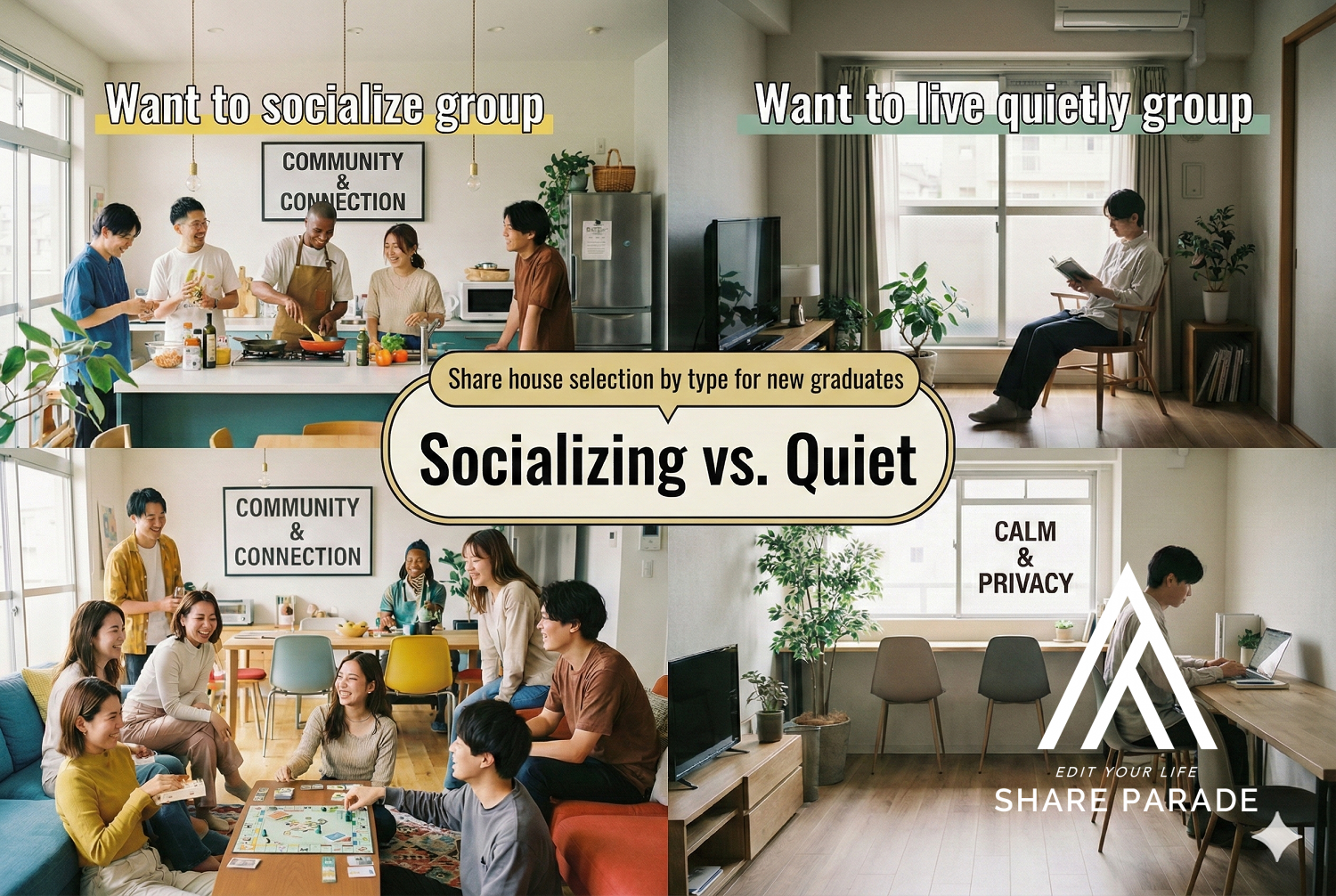
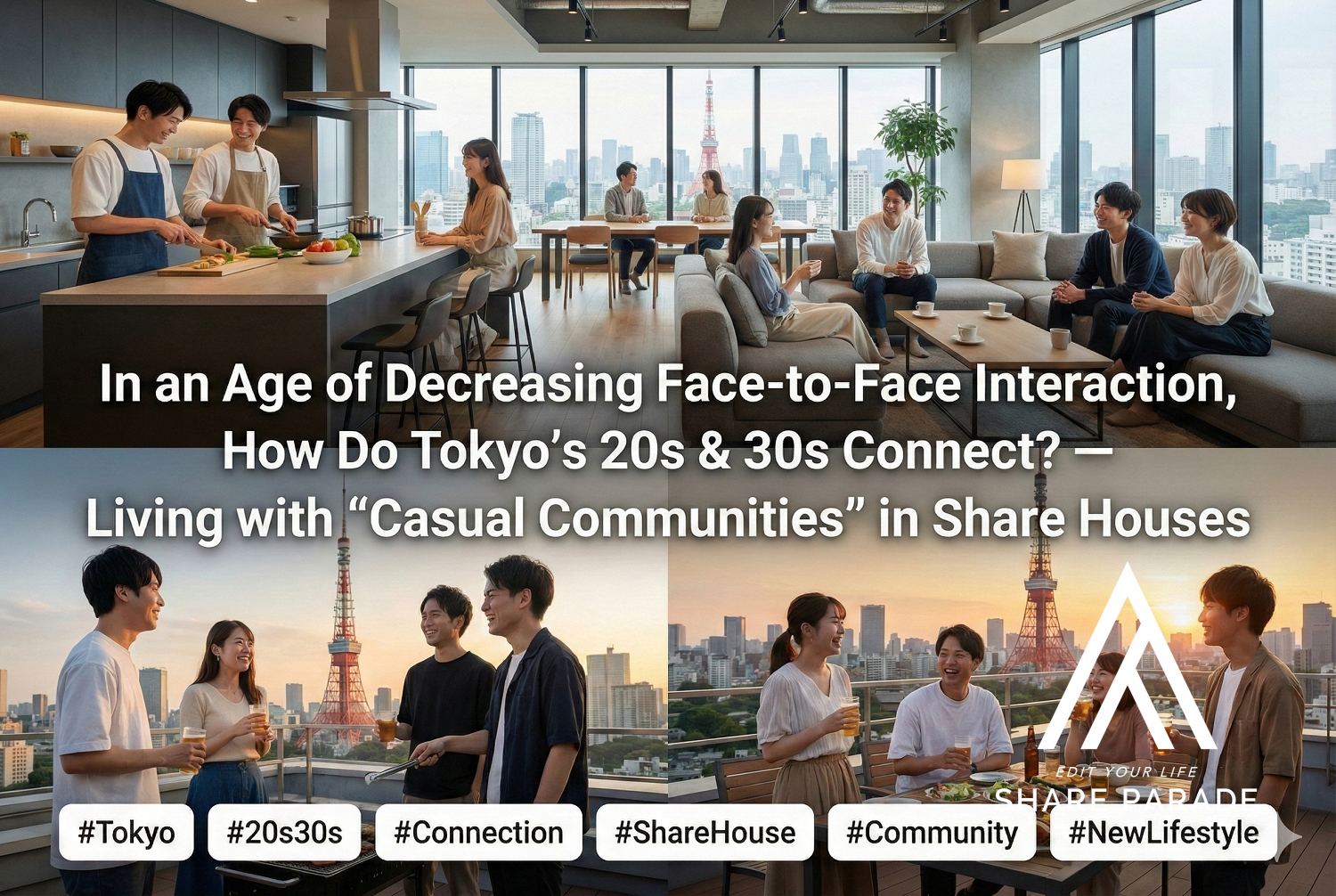
A common misunderstanding here is “share = lively every day.” That is not the point. Being able to greet someone, have a short chat, or ask one quick question when you are stuck—those light points of contact can soften the anxiety of the early study-abroad period. Some people need deeper交流, but not everyone does.
A rough guide to “how tough it feels” (right after arriving)
*There are individual differences, but for many people the “first peak” comes early.
| Period | Common triggers of a “mental crash” | Example failure in a new life in Japan | Practical measures that actually help |
|---|---|---|---|
| Arrival–1 month | Language fatigue / paperwork fatigue / life not set up / lack of sleep | “The Wi-Fi is unstable, and I still don’t even have a desk. I have assignments due, but my environment isn’t ready. I come home at night and my room is still basically ‘temporary housing.’ I can’t feel settled.” | Make daily-life setup lighter (furnished / Wi-Fi included / a home with fewer procedures) |
| 1–3 months | Loneliness / cultural friction / empty weekends / exhaustion from cooking & part-time work | “Weekends feel empty. I sleep until noon, go to the convenience store, then back to bed. The day ends without speaking Japanese. Suddenly anxiety hits on Sunday night.” | Create a system that reduces “zero-conversation days” (a place where greetings happen / a light sense of belonging / habits outside the house) |
| When classes become serious (midterms–finals) | Assignment volume / speed of Japanese / group work / lack of a study environment | “Classes are too fast to keep up with, and I can’t concentrate at home. Living noise and crowded common areas stop my studying, deadlines slip, and self-hate grows.” | Prioritize your study environment above all (a desk & chair in the room / quiet-hours rules / measured Wi-Fi speed / how common areas are managed at night) |
You may read this and think, “So is studying abroad in Japan dangerous after all?”
No. What is dangerous is choosing housing without checking. Many failures can be seen before you move in. It is as simple as that.
I will write the failures in concrete terms. The more you can imagine them, the more you can avoid them.
If you read and think “This could happen,” that is your key risk point.
For international students, many things are only clear after you arrive. Rebuilding your timetable, changes in how many classes are in person, group work, part-time jobs, and your life rhythm. Parts you cannot control by your will alone tend to increase. So if you carry too much “weight” in fixed housing costs, it becomes difficult to adjust.
That is where a share house shows its strengths. It is not only that initial costs and the hassle of furniture and appliances are light—the key point is another one: how easy it is to move. When commuting or daily life reaches its limit, can you choose moving as a way to rebuild? This directly affects your mental health.
| Situation | Common failures in a new life in Japan | Moves that are easier in a share house | What to confirm first |
|---|---|---|---|
| The commute was harder than expected | You get削られて daily and cannot recover / moving feels like a hassle so you keep enduring | Short-term moves make it easier to optimize your commute | Minimum contract term, move-out notice period, and penalty conditions |
| Online → more in-person classes | The location and life rhythm don’t fit and you get drained every day / you can’t secure study time | You can move to match the “reality of commuting” | Trying the commute on a weekday morning, number of transfers, route from the station |
| Your mental state dropped / studying stopped | Loneliness drags on / you can’t ask for help and delays spread / life collapses into a vicious cycle | Light conversation and the presence of others may make recovery easier in some cases | Whether social pressure is low, whether quiet rules are clear, residents’ schedules, and the study environment (desk / Wi-Fi) |
What matters is not “hitting the perfect choice from the start.”
Start in a way that does not break. Then optimize after you get used to it.
In the end, this order is faster.
This is not about “the more questions, the better.”
If international students at least cover these points, most landmines can be avoided.
For international students, the first few months of a new life in Japan are the crucial period.
The difficulty of classes and the load of Japanese do not drop immediately. That is why you need a housing setup that lets you recover.
A share house is powerful for people it fits. If it does not fit, it drains you. Both are true.
But if you confirm living noise, cleaning, guests, study time, compatibility, and contract terms—and prepare an escape route—you can properly reduce the risk.
Start light. Optimize after you get used to it.
If you are searching “share house Tokyo international student,” start with a “not-tiring way to choose.”

SHARE PARADE(シェアパレード) の運営責任者です。「EDIT YOUR LIFE ― 今の暮らしをちょっと変えてみる」を合言葉に、**コミュニティのある暮らし(Community Living)**を中心としたシェアハウスを紹介しています。2011年の立ち上げ以来、東京全域で800件以上を現地取材。私自身も一人暮らし/シェアハウス/ルームシェア/ソーシャルマンションを一通り経験しており、一次情報と体験の両方を基準にサイトを運営しています。「住む場所が変われば、ライフスタイルも変わる」。コミュニティがある暮らしの楽しさと安心を、もっと当たり前の選択肢に――それがSHARE PARADEの役割であり、私のミッションです。 I am the administrator of the website 'SHARE PARADE.' Under the motto “EDIT YOUR LIFE—make a small change to your everyday,” we feature share houses centered on community living. Since our launch in 2011, I have visited and reviewed more than 800 properties across Tokyo. I’ve personally experienced living alone, in share houses, in room shares, and in social apartments, and I run the site based on both first-hand information and lived experience. I believe that when your home changes, your lifestyle changes too. My mission—and SHARE PARADE’s role—is to make the joy and peace of mind of community living a more everyday choice.